Unlocking Peak Drift Potential With Telemetry and Precision Setup
Inside the high-stakes arena of modern serious sliding, success is far more than exclusively a result of brute horsepower or behind-the-wheel courage. Conversely, it has evolved into a complex engineering challenge that necessitates a painstaking fusion of picking a inherently capable chassis, arming it with the most precise performance parts, and, most critically, comprehending its live behavior on the course through advanced drift telemetry software. This comprehensive manual acts as your master plan from the very first idea of a drift build right through to the last engineering-refined adjustments that elevate a strong vehicle into a consistent podium finisher. We will delve deep into the precise engineering of chassis dynamics adjustment, demonstrating how a modern drift tuning app like GripDial removes assumptions and provides unmatched visibility into your chassis's true behavior.
The foundation of any exceptional drift machine is, undoubtedly, the base vehicle itself. Several platforms have achieved legendary standing within the international oversteer scene due to their built-in balance, robust construction, and the vast ecosystem of performance parts available. Choosing the optimal car is the initial and most important selection a driver will make. To illustrate, the the E36 generation BMW is widely regarded as perhaps the the best all-around drift platforms of all time. Its near-perfect balanced front-to-rear weight, coupled with a rear-wheel-drive setup and robust straight-six engines, creates a car that is simultaneously forgiving for beginners and incredibly competitive in the hands of a expert competitor. The successor of this lineage, the BMW E46, refines these attributes with a more developed structure, wider wheel track for improved high-speed stability, and yet more turning capability straight from the OEM. A distinct powerful contender in the professional arena is the C6 generation Corvette.
This muscle-derived performance car brings a particular combination of benefits to the sliding world, including a lightweight alloy frame, a rear-mounted transaxle that helps create an ideal balance, and the colossal low-end power of a large-displacement GM LS engine. This combination transforms it into an absolute monster on track, capable of starting and maintaining continuous slides with relatively effortless deployment of power. For those desiring exceptional performance per dollar, the 350Z model Nissan excels as a excellent example. It comes from the factory with a robust platform, a effective factory limited-slip differential, and the responsive VQ series powerplant that provides sufficient horsepower and torque for practicing and progressing in the activity. Its successor, the 370Z model, offers additional refinements in body strength, steering geometry, and overall powerplant output, establishing its place as a favorite choice among serious competitors. Other legendary platforms that deserve mention include the lightweight rotary-powered Mazda FC RX-7, the ubiquitous Nissan S13 240SX, the torque-rich Ford Mustang SN95, the modern BMW E90, and the compact yet unbelievably engaging and forgiving Mazda MX-5. Every single one of these cars offers a different set of attributes, complexities, and capabilities, but they all have in common the fundamental ingredients essential to serve as a capable drift machine.
However, selecting the optimal car is only the beginning. To access the full potential of every of these machines, significant modifications to the steering geometry and damping and springing systems are completely non-negotiable. This is where the domain of precision drift-spec hardware enters sharp importance. The one most transformative improvement for a serious drift machine is the fitting of a high-performance drift angle kit. These sophisticated kits, for example those engineered by industry leaders like SLR, are created to radically expand the car's possible turning lock. A standard road car is severely constrained in how far its front wheels can pivot, a design limitation for public road driving. In drifting, but, extreme steering input is continuously needed to control and sustain a drift. An modification kit substitutes the stock hubs, rod ends, and often suspension arms with parts that enable the front tires to achieve angles in excess of 70 or even 80 degrees, versus a normal OEM limit of around 40 to 50 degs.
This immensely increased steering angle offers the operator with dramatically greater command during a drift, making it considerably simpler to initiate a oversteer moment, hold it through a extended corner, and transition fluidly from one angle to another. The improvement in handling is absolutely revolutionary. Combined with a correctly selected modification is the just as critical enhancement to the car's suspension. Generic or even expensive road coilovers are just not designed for the particular and brutal needs of sliding. A drift-spec pair of suspension units is crucial. These specialized dampers feature specific piston tuning and spring stiffness that are designed for the rapid mass transition that is characteristic of aggressive driving. When a driver starts a drift, the car's inertia is thrown rapidly to the front of the corner. Correct drift-spec dampers handle this transfer in a consistent fashion, enabling the vehicle to settle rapidly and offering the driver precise feel through the controls and seat. They additionally provide precise adjustment of ground clearance, shock absorber stiffness, and cross-weight, which are all key elements of fine-tuning the vehicle's behavior to a particular venue or competition style. Together, a top-tier drift angle kit and a correctly selected system of performance suspension units are the absolute mechanical foundation upon which all later optimization is constructed.
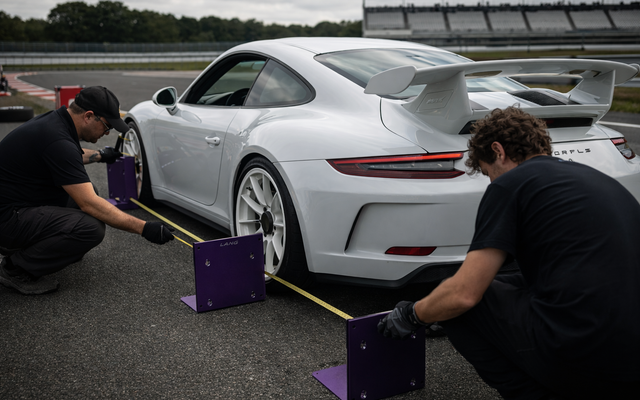
Once the fundamental components is in place, the subsequent essential stage in the development is the detailed setting of the vehicle's alignment. This is the world of car suspension tuning, a procedure that can seem overwhelmingly complex to the uninitiated but is, in fact, the key to transforming a assembly of high-performance parts into a harmonious and consistent machine. The most debated parameter of tuning for oversteer is definitely negative camber. Camber is the tilt of the tire compared to the upright plane when observed from the front-on of the chassis. When the top edge of the wheel is angled towards the car, this is known as camber-in. For sliding, an inward tilt on the front axle wheels is universally employed and is seen as critical. The purpose is deeply linked to vehicle dynamics.
When a chassis is going around a bend at limit sideways angles, the chassis rolls to the outer of the turn. This body roll forces the outside front tire to diminish its optimal contact patch with the track surface. By introducing negative camber, the wheel is pre-tilted to account for this lean. As the chassis rolls into the corner, the outside front tire becomes more upright against the road surface, optimizing its grip at the critical moment when it is absolutely essential for steering authority. Commonly, front adjustments for a serious drift car vary from approximately -3 degrees to as high as -5 degrees or even greater, contingent on the details of the vehicle setup, rubber choice, and pilot feel. The rear tires also employ negative camber, but the values are generally more modest and more nuanced than the front. Overly aggressive negative camber at the back can make the car excessively prone to oversteer and difficult to manage on acceleration application, as it diminishes the usable contact patch of the powered tires during linear acceleration. Thus, rear axle adjustments are often in the ballpark of -1 degree to -3 degrees, achieving a careful equilibrium between providing enough side traction to help in starting and sustaining the angle while still preserving good grip for exiting the bend. alignment is just one element of the broader suspension geometry equation, which additionally involves toe setting, caster, and steer correction adjustment.
Toe setting refers to the direction of the tires as seen from a bird's-eye view. Positive toe means the leading edges of the wheels are closer together than the rear edges, while toe-out means the reverse. For sliding, a slight amount of front axle negative toe is commonly employed to quicken the turn-in directional feel, making the chassis feel more responsive and ready to initiate a slide. Rear toe setting is generally set to neutral or a incredibly slight amount of toe-in to foster predictability under throttle. self-centering is the longitudinal or aft angle of the suspension pivot when observed from the lateral of the car. Increased positive caster improves steering feel and high-speed stability, and it furthermore boosts inward lean gain during cornering, which is extremely useful. Tuning these parameters is a detailed dance where a adjustment to one value can and often will affect the remaining parameters. The conventional approach for dialing in a chassis's alignment for competition has for a long time been a time-consuming endeavor of experimentation and feeling. A pilot or team would introduce a adjustment based vehicle dynamics tool on experience, test the car on track, depend on the pilot's individual sensation and feedback, and then introduce another tweak. This loop would iterate again and again until the car felt "right" or the available track session ran out. This approach is not only extremely inefficient in terms of hours and resources, but it is additionally fundamentally inaccurate.
Pilot perception is a famously unreliable metric, influenced by numerous elements such as fatigue, varying track grip levels, ambient heat, and merely the mood of the driver on that given day. What feels "oversteery" on one pass might feel "tight" on the following pass, resulting in contradictory feedback and counterproductive adjustments. This traditional problem in car suspension tuning is exactly where state-of-the-art technology has intervened to transform the process.
The advent and adoption of specialized vehicle dynamics tools has brought about a radically different paradigm for building and optimizing competitive drift machines. This new generation of tools, showcased by innovative products like GripDial, operate by physically capturing the actual dynamic performance of the chassis as it is piloted on the circuit. In contrast to using personal feedback, these systems acquire quantifiable data on critical variables such as suspension travel, individual tire rotation, G-force loading, wheel angle, and accelerator and brake pedal position. This collected information flow is then processed by advanced software that can visualize and interpret the data in a actionable way. For the very first time, engineers and crews can see specifically what the vehicle is performing at any given moment of a drift. This ability changes the entire suspension tuning workflow. Imagine the particular challenge of setting the front axle camber for a specific chassis. As an alternative to making a adjustment from car alignment tuning -3 degrees to -3.5 degrees and then testing multiple runs to try and "feel" a difference, a telemetry system can deliver immediate and definitive data. The software can indicate graphically how the tire's grip is behaving during the key phases of a angle: turn-in, holding the angle, and switch. It can demonstrate if the present camber setting is permitting the outside front tire to achieve optimal loading or if the tire is working inefficiently on its outside shoulder.
The system can after analysis make fact-based recommendations for change. Perhaps the data indicates that the outside front tire is still stressing its outer shoulder at -3.5 degrees of camber, implying that even more inward lean, say -4 degrees, might be beneficial. On the other hand, the information might reveal that the tire is not achieving temperature or drift telemetry software that the inner edge is degrading excessively, which could indicate that there is overly aggressive negative camber and a slight decrease back to -3.2 degrees would be more ideal. This standard of granularity and actionable intelligence was literally impossible in the era of pure manual setup.
The benefit of utilizing a advanced drift telemetry system reaches far beyond merely optimizing camber angles. It serves as an priceless damper adjustment manual that is specific to your exact car. When adjusting the rebound and compression values on your adjustable dampers, rather than depending on imprecise tips or mimicking another team's settings, you can utilize the data to analyze how the vehicle is performing in response to your tweaks. The application can graph the wheel movement data over a section of track, highlighting if the coilovers are handling the chassis motion optimally or if they are permitting the chassis to oscillate excessively after a transition. It can help in diagnosing issues like bottoming out or losing droop, allowing you to apply data-backed decisions to spring preload, rebound/compression values, or stance. This process applies similarly to the detailed art of corner balancing. Beyond camber, the system can offer data into how changes to toe settings and caster angle are affecting the vehicle's handling during various maneuvers of a lap. For example, it can allow you to ascertain the optimal amount of front axle toe out for your specific angle kit configuration and competition technique by measuring the response time of initial reaction and the consistency of the chassis at maximum steering angle. This transforms the system an exceptionally effective drift suspension tuning guide that is constantly informed by the real-world performance of your specific vehicle on the track. It moves the whole endeavor from a mysterious craft into a repeatable development procedure.
Moreover, the utility of a tool like modern telemetry is in no way restricted to experienced tuners with vast funding. For the amateur competitor, it acts as an incredible force multiplier. It effectively gives the builder with the analysis of a professional race engineer without requiring the typical expense. It speeds up the learning curve by providing unambiguous solutions to challenges that would traditionally take seasons of trial and error to answer. A tuner can learn how their specific car behaves to various adjustments, gaining a more profound comprehension of suspension theory in the process. It additionally democratizes high-level chassis dynamics techniques, permitting anyone with the drive to optimize their machine to accomplish it in a efficient and effective manner. This is particularly significant in a activity like drifting, where tuning knowledge has historically been a closely guarded commodity among elite drivers. Today, that capability can be in the garage of every serious driver.
In the final analysis, the journey to building and dialing in the perfect championship-contending sliding vehicle is a comprehensive mission that smoothly combines proven hardware wisdom with revolutionary data technology. It begins with the strategic selection of a proven car, then built upon the application of essential drift-spec hardware like high-performance steering angle kits and correctly valved drift-spec coilovers. The build then progresses into the detailed stage of car suspension tuning, where settings like camber, toe setting, and caster angle are meticulously adjusted to complement the car's new hardware and the pilot's specific style. Ultimately, and what truly differentiates the today's methodology from the past, is the use of a advanced drift telemetry software. This platform eliminates the approximation and waste of only feel-based tuning by delivering objective, live data on how the car is actually functioning. It acts as an unparalleled suspension tuning tool, a actionable coilover setup manual, and a all-in-one performance analyzer. As a complete package, this holistic philosophy ensures that each and every aspect of the drift machine—from the pick of the chassis to the last tweak on the coilover—is refined for ultimate performance on the competition venue. It represents the full maturation of the sport of sliding, merging mechanical car control with data-informed suspension engineering to build the perfect dominant machines imaginable.